












In 2026, app monetization is no longer the wild-west era where you could simply upload an APK to Google Play and earn passively. More developers are discovering that users download, open, and even register — but never pay. User acquisition costs keep rising, while LTV remains stagnant.
As global expansion enters the era of refined operations in 2026, many developers notice that even though downloads are increasing, monetization efficiency (LTV) remains low.
In many cases, the problem is not product features, but the absence — or failure — of localization testing.
This article examines real monetization pain points, breaks down core localization testing scenarios, explains why most tests are ineffective, and provides actionable localization testing strategies for 2026.
I. Why Your Global App Has Users but No Revenue
Many apps have millions of DAU in Southeast Asia or Latin America, yet ARPU remains extremely low. The root cause is often the gap between the user experience simulated in the office and real local user perception.
- Ad Display Mismatch
When Southeast Asian users see Western models with English CTA buttons, trust decreases and click-through rates drop. eCPM can fall from $8 to $2.
Ad platforms also return content based on IP location. Without local environment testing, developers never see the actual ads shown to users. - Paywall Localization Issues
High-converting paywalls in North America may fail completely in Latin America. Reasons include incorrect currency symbols, missing local payment methods like Pix or OXXO, or subscription cycles that don’t match local salary patterns.
Untested paywalls are one of the biggest obstacles to LTV growth. - A/B Testing Bias
99% of teams run unified global tests due to high testing costs. Using North American conclusions to guide global markets often leads to incorrect optimization decisions because cultural and geographic differences can reverse experiment outcomes. - Risks Of Cultural Friction
Payment logic that feels unnatural locally, or content that unintentionally violates religious or cultural norms, will instantly damage brand trust. - Contaminated Testing Environment
Using data center IPs for monetization testing can trigger ad fraud detection systems. This results in distorted data and may even lead to developer account penalties.
In short, users are not paying because your product doesn’t speak the local language, follow local norms, or understand local behavior. Localization testing is the only way to fix this.
II. Core APP Localization Testing Scenarios
- Ad Verification
Ad inventory varies significantly across countries. Developers should verify:• Interstitial and rewarded video loading
• Compliance with local religious and legal standards
• Presence of malicious or disruptive ads - Conversion Funnel Testing
From tapping “Buy” to completing payment, every step should be tested under local network conditions.
Local payment gateways such as Pix or Dana must load smoothly. - Content Recommendation Testing
Short video, news, and ecommerce apps rely heavily on algorithms. Developers must simulate local user interest graphs and confirm that recommendation engines reflect local trends rather than global content. - Multi-Market A/B Testing
Running two creatives simultaneously in Brazil and India may produce different results. Only geo-accurate A/B testing provides reliable decision-making data.

III. Why Most Localization Tests Are Ineffective
If you are still using traditional servers or cheap data center proxy solutions, your test results are likely inaccurate:
• Risk control filtering — Ad platforms identify data center IPs and block ads or return fake content
• Geo-fencing limitations — High-value ads may only appear for specific cities and residential networks
• Latency bias — Data center speeds differ significantly from real 4G/5G mobile networks
• Emulator limitations — Simulators cannot replicate device fragmentation, hardware performance, and real network conditions
In emerging markets, low-end Android devices expose memory and compatibility issues that only real devices can reveal. GPS simulation and language switching in emulators also cannot fully replicate real user environments.
IV. Localization Testing Strategies for Mobile Monetization in 2026
1. Geo Testing Framework
Build a distributed testing system. Instead of relying on a single test location, use proxy infrastructure to create global virtual nodes and automatically collect UI screenshots and performance logs.
Key elements:
① Geographic Simulation
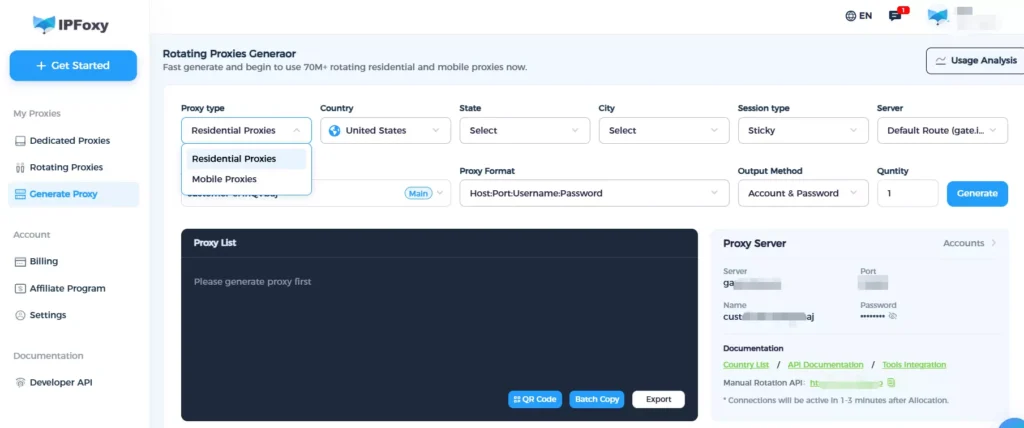
Use professional global residential proxy providers such as IPFoxy Proxies to obtain real residential IPs from target countries. Residential IPs are closer to real users and less likely to be blocked by ad platforms or risk control systems.
Rotating residential proxy solutions support automated validation with continuous IP rotation, helping bypass anti-bot detection.
② Combine with Anti-detect Browser
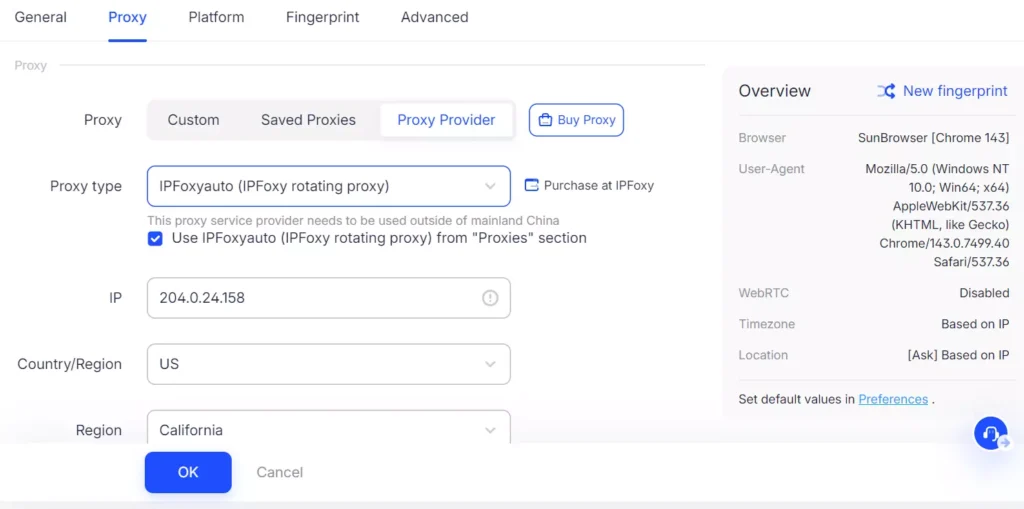
For multi-account isolation scenarios such as multi-market A/B testing and ad verification, Anti-detect browsers like AdsPower or Gologin can be used.
Each browser profile is configured with a separate proxy, simulating independent users.
③ Device-Level Geo Testing
Mobile testing should use real devices combined with proxy solutions. This allows testing of IP-based behaviors such as:
• Regional in-app store content
• Geo-based ad SDK requests
• Third-party SDK location reporting (e.g., Firebase)
2. Important Checklist
The following checklist can be directly used in testing workflows:
• UI/UX adaptation — Check language overflow (German, Arabic RTL layouts)
• Payment consistency — Currency symbols, decimal formats, tax calculation
• Compliance requirements — GDPR, CCPA, and local privacy regulations
• Network compatibility — Monetization component behavior under weak network conditions
3. Real User Environment Simulation
Accurate testing requires real device environments:
• Real Device Cloud Testing + Local Testing Labs
Select mainstream devices in target markets (e.g., low-end Xiaomi or OPPO A-series devices in Indonesia). Combine with proxy solutions for real device and real IP simulation.
• Crowdtesting + Local QA Outsourcing
Hire freelancers in target countries through Upwork or Fiverr, or launch localization testing via platforms like Appen or Lionbridge.

V. Conclusion
Returning to the original question: why does your global app have users but no revenue?
The answer may lie in overlooked details — a truncated button, incorrect currency symbol, or promotion that never triggers due to incorrect IP localization.
Individually, these issues seem minor. Combined, they cause user drop-off and monetization failure.
Start taking localization testing seriously today. When users in every market feel that your app is designed specifically for them, monetization becomes a natural outcome.