











In 2026, the global AI Agent market is expanding at an astonishing pace. According to China Merchants Industry Research Institute, the global AI agent market is expected to reach $17.5 billion in 2026 and exceed $47 billion by 2030.
In this wave, the core factor determining what Agents can do—and how well they do it—is Agent Skill. Agent Skill bridges the final gap between large model cognition and real-world execution, marking the transition from prompt engineering to skill engineering.
This article provides a comprehensive 2026 AI Agent capability guide, covering core concepts, the top 10 skills, and how to acquire them.
I. What is Agent Skill?
In 2026, we are no longer just discussing large models, but Agents with execution capabilities. Agent Skill is a standardized module that enables Agents to perform specific tasks.
From a technical perspective, Agent Skill is a standardized folder structure. The core file is SKILL.md, which defines execution workflows and rules. Additional components may include scripts/ (executable scripts), references/ (reference documents), and assets/ (attachments and resources). Skills adopt a progressive disclosure architecture, allowing models to dynamically load only necessary rule segments during reasoning, significantly reducing context token consumption. As of early 2026, more than 85,000 public Agent Skills are available, with 27 major platforms supporting the standard.
To better understand, consider the following comparison:
| Concept | Definition | Analogy |
| Prompt | Instructions for AI | Verbal command to an employee |
| Agent | Intelligent entity with cognition and action | The employee |
| Agent Skill | Standardized capability plugin | Professional certification or SOP |
| MCP | Model Context Protocol connecting models and data | Company internal network interface |
| Rules | Behavioral boundaries and logic constraints | Company policies |
| Memory | Long‑term storage of tasks and preferences | Work experience and client records |
II.10 Essential AI Agent Skills for 2026
1.Tool Calling Skill
Tool calling is the key capability that transforms Agents from talking to acting. Tool Calling Skill enables Agents to identify, invoke, and orchestrate external tools and APIs, including dynamic API adaptation, secure code sandbox execution, and cross‑service orchestration. In 2026, tool calling is evolving from single‑tool execution to complex cross‑system workflows.
2.Web Automation Skill
Web Automation Skill allows Agents to browse websites, fill forms, click buttons, and extract data like humans. It supports headless browsers, real browsers with profiles, and cloud remote browsers, covering navigation, inspection, data extraction, and JavaScript execution. This capability is foundational for web‑based automation.
3.Data Collection Skill
In data‑driven environments, data collection enables Agents to gather public information efficiently. Agents can scale data collection from e‑commerce platforms, social media, and search engines for price monitoring, sentiment analysis, and market research.
When building data collection and automation skills, the underlying network infrastructure becomes a critical factor. If proxy quality is insufficient, even well‑designed Agents may face frequent blocking.
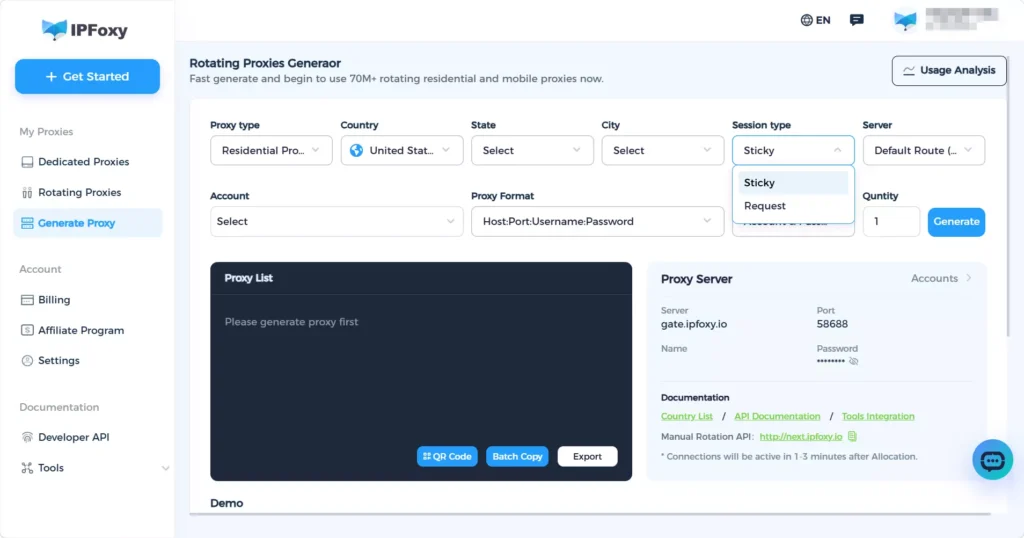
In such scenarios, professional AI teams often useIPFoxy Proxies as foundational infrastructure, providing:
• Authenticity: 90+ million residential IP resources that reduce blacklist risks
• Flexible logic adaptation: support for sticky sessions and rotation
• Full‑scenario coverage: from price monitoring to ad verification
4.Memory Management Skill
Memory Management Skill enables Agents to retain past information. This includes short‑term memory (session context) and long‑term memory (RAG‑based knowledge retrieval). Advanced memory management supports hybrid search, reranking, and persistent states, allowing Agents to maintain preferences and task progress across sessions.
5.Planning and Task Decomposition Skill
Planning Skill allows Agents to break complex goals into executable tasks. Core reasoning patterns include Chain‑of‑Thought and ReAct frameworks. In 2026, task decomposition is evolving toward parallel exploration and self‑correction.
6.Multi‑Agent Coordination Skill
Multiple Agents collaborate when single‑Agent capabilities are insufficient. A manager Agent decomposes tasks, execution Agents perform operations, and audit Agents verify results.
7.Code Review and Quality Assurance Skill
This capability allows Agents to review code, identify bugs, optimize performance, and assess security. Advanced implementations deploy multiple review Agents simultaneously.
8.PDF and Document Processing Skill
Agents can read, parse, and extract information from PDF and document formats, including table extraction, text analysis, and format conversion.
9.Security and Compliance Governance Skill
Security governance ensures Agents operate within defined boundaries, including permission management, audit logs, and privacy compliance.
10.Cross‑Service Integration Skill
Cross‑Service Integration enables Agents to connect Gmail, Slack, GitHub, Notion, and other SaaS platforms to build automated workflows.
Example: When a GitHub PR is created, automatically send a Slack notification and create a Notion task.
III. How to Get AI Agent Skills?
1.Direct Acquisition from Community Ecosystems
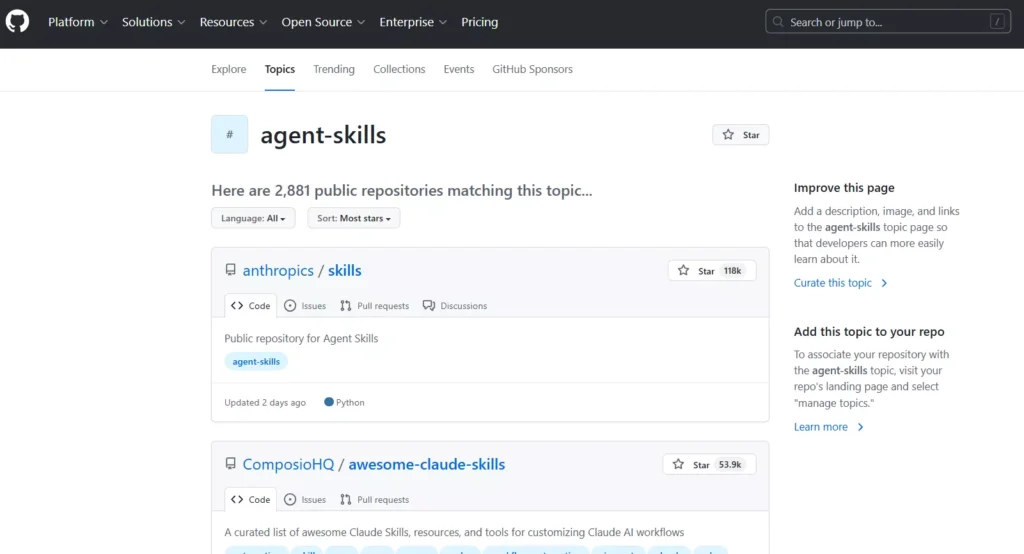
In 2026, the Agent Skill ecosystem is mature. Common sources include:• skills.sh ecosystem: install using npx skills add
• GitHub open‑source repositories
• Anthropic official Skills
• Awesome Cloud Skills
• OpenClaw ecosystem
2.Create Custom Skills
When existing tools cannot meet requirements, developers can create custom Skills using skill‑creator.Workflow:
Capture intent → Draft Skill → Create test prompts → Evaluate → OptimizeStandard structure:
SKILL.md
references/
scripts/
assets/
3.Platform Support
Mainstream platforms including Coze, Dify, and OpenClaw support one‑click Skill import, reducing development complexity.
Ⅳ.Conclusion
In 2026, AI development is transitioning from prompt engineering to skill engineering. As large models evolve from conversational systems to execution engines, Skills become the key to unlocking real productivity.
Agent Skill establishes an engineering‑based capability system—transforming temporary prompts into reusable, composable digital assets. For developers, product managers, and enterprise leaders, mastering Agent Skills will become a core competitive advantage in 2026.