











If you are new to network technology, web scraping, e-commerce, or international business operations, the two high-frequency terms “VPS (Virtual Private Server)” and “Proxy” will often appear around you. At this time, you will face the dilemma of choosing whether to rent a remote server (VPS) or configure a clean proxy.
How should we distinguish and choose between the evolution from VPS (Virtual Private Server) to proxy? This article will dive deep into their respective roles, essential differences, and application scenarios to help you make a better choice for your business.
I. VPS and Proxy: What Roles Do They Play in Network Requests?
1. Normal Browsing—Visiting in Person
You access the website directly without any intermediary. The target website can see your real IP address at a glance, leaving you with no privacy.
2. Using a VPS—The Fixed Stand-in
You remotely control a fixed server to access the website.
- Advantages: Independent environment, stable, and controllable.
- Disadvantages: The stand-in has only one face. Once the IP is blacklisted, the entire VPS is completely scrapped, resulting in high costs and zero flexibility.
3. Using a Proxy—The Multi-Faceted Intermediary
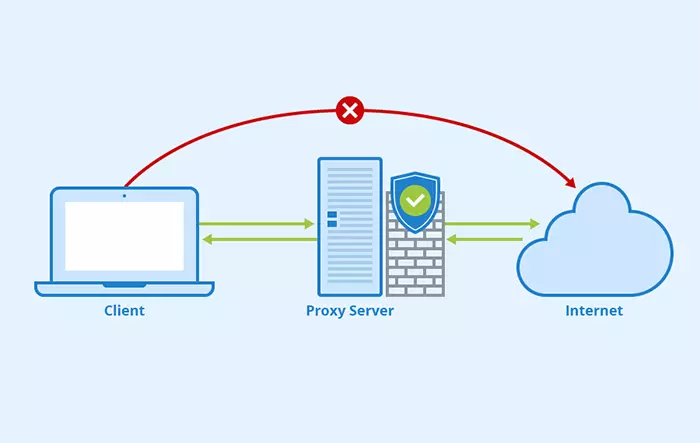
You do not need to switch computers; you only need to configure the network gateway to let the proxy server forward your requests.
- Advantages: Change to a new face at any time. It can dynamically rotate the outbound IP from a massive IP pool, so websites can never capture your real address, making it highly efficient and flexible.
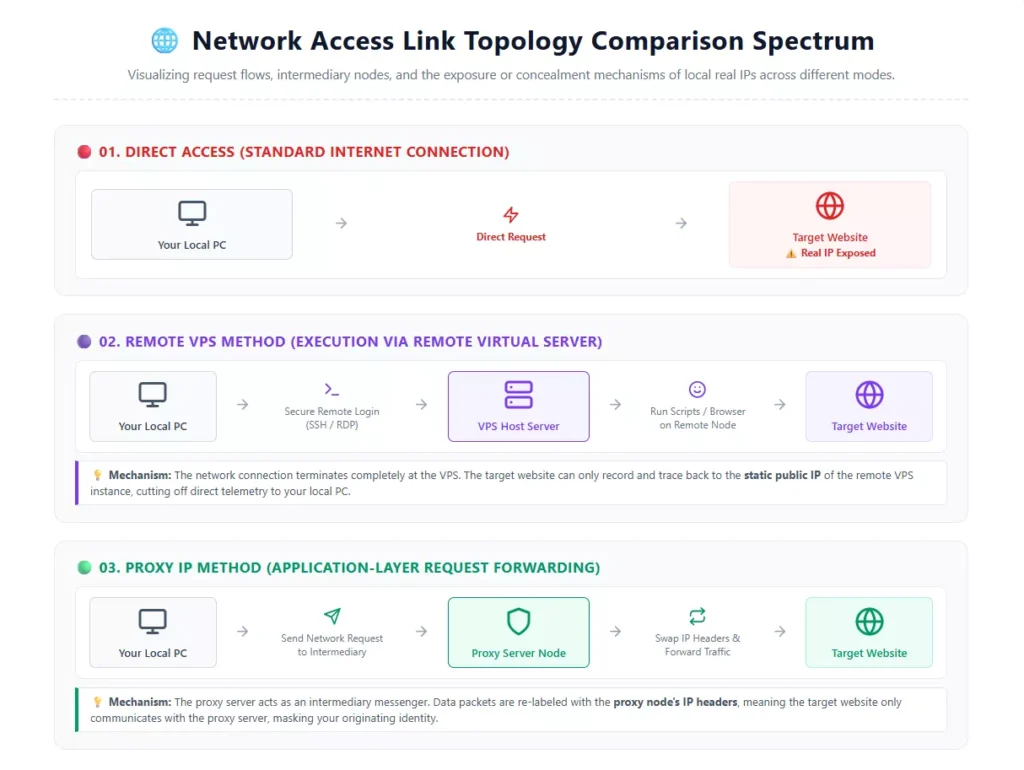
To summarize in one sentence: A VPS is equivalent to equipping yourself with a “remote computer,” while a proxy is equivalent to putting on different “network coats” while the computer remains your own.
II. VPS and Proxy: Essential Differences and Underlying Logic
| Comparison Item | VPS (Virtual Private Server) | Proxy |
| Essence | A complete remote computer | A gateway that forwards traffic and hides identity |
| Functional Logic | Provides an independent operating system and hardware environment | Request forwarding and protocol relay, does not provide computing resources |
| Can Install Software | Yes, has full control over the operating system | No, only responsible for forwarding network requests |
| IP Type | Fixed public IP (usually data center IP) | Data center IP, residential IP, and mobile IP are all available |
| Anonymity/Weight | Data center IP, easily recognized as a machine environment | Residential/mobile IP, closer to real users |
| Main Purpose | Hosting websites, running programs, building services, managing stores | Hiding real IP, switching geographical locations, bypassing risk control |
| Direct User Operation | Yes (via SSH/Remote Desktop) | No (only requires configuring proxy tools) |
| Cost Model | Rented monthly, higher fixed cost | Flexible billing based on traffic, number of IPs, or duration |
| Fixity | Fixed system environment and hardware fingerprints | IP can be fixed or rotated, needs to be paired with an Anti-detect browser |
1. The Operating Logic of VPS—Virtualization Resource Isolation
A VPS is like a “small independent room” carved out of a high-configuration physical server using technology. It has its own virtual CPU, memory, and hard drive, and runs an independent Windows or Linux system.
Fatal weakness: Its network IP is directly assigned by the machine room switch, and the traffic goes through the data center backbone network. This makes its background (data center IP) completely transparent to platforms, making it extremely easy to be identified as a robot environment.
2. The Operating Logic of Proxy—Request Forwarding and Protocol Relay
A proxy does not provide any computing resources; it is only responsible for forwarding traffic. During network transit, it quietly replaces your real IP with its outbound IP.
Advanced disguise (residential proxy): Its traffic uses technical means to detour into ordinary residential homes around the world (via ISP broadband servers). When the target website checks the TCP three-way handshake signal, it will determine that this is a real user surfing the internet, thereby achieving “seamless disguise” at the algorithm level.
III. What Scenarios Are VPS and Proxy Respectively Suitable For?
1. VPS (Virtual Private Server)
If the core needs of your business are “stable online presence” and “fixed environment,” a VPS will be more suitable.
- Long-term operation: Daily maintenance of established e-commerce stores such as Amazon and eBay requires an operating space that is completely physically isolated and will not change.
- Lightweight tasks: Running financial software, ERP systems, automated customer service, scheduled scripts, etc.
- Management of a small number of fixed accounts: If you only manage one or two core accounts and do not need to frequently change regions or IPs, the stability of a VPS offers more advantages.
- Building websites or applications: Hosting independent websites, databases, corporate applications, or for technical personnel to learn Linux and deploy services.
- Advantages: Clean environment, complete isolation, not easily detected by platforms for association. Disadvantages: You need to buy multiple VPS units for multiple stores, which causes costs to skyrocket; managing dozens of VPS units is highly inefficient.
2. Proxy
As platform risk control becomes stricter, many platforms look not only at the device environment but also heavily inspect the IP source, region, purity, and access behavior. Proxies offer higher flexibility in these scenarios.
- Operations/Live Streaming: Needs to simulate the user environment of the target region, and residential proxies are closer to real home broadband.
- Multi-account matrix management: Paired with an Anti-detect browser to configure independent proxies for different accounts, reducing the risk of association.
- Data collection and automated access: When scraping web pages, monitoring prices, or collecting public data, proxies can disperse request sources and lower the probability of being blocked.
- Ad verification and regional testing: Switch to IPs of different countries or cities to view local ad displays and search result differences.
- Social media account operations: Maintenance of multiple accounts on Facebook, Instagram, etc., to avoid bans caused by same-IP association.
- Advantages: The cost is far lower than a VPS. A single Anti-detect browser can manage all stores, and proxies can be purchased on demand and switched flexibly. Disadvantages: A standalone proxy does not provide an operating system environment and must be used in conjunction with a local computer or an Anti-detect browser.
IV. From VPS to Proxy: How to Choose a Proxy Service?
In recent years, as businesses demand higher IP switching frequency and geographical location diversity, everyone has begun to migrate from “VPS” to a lightweight architecture of “Anti-detect browser + proxy”. Behind this is not a simple tool replacement, but an improvement in business efficiency and the continuous upgrading of platform risk controls.
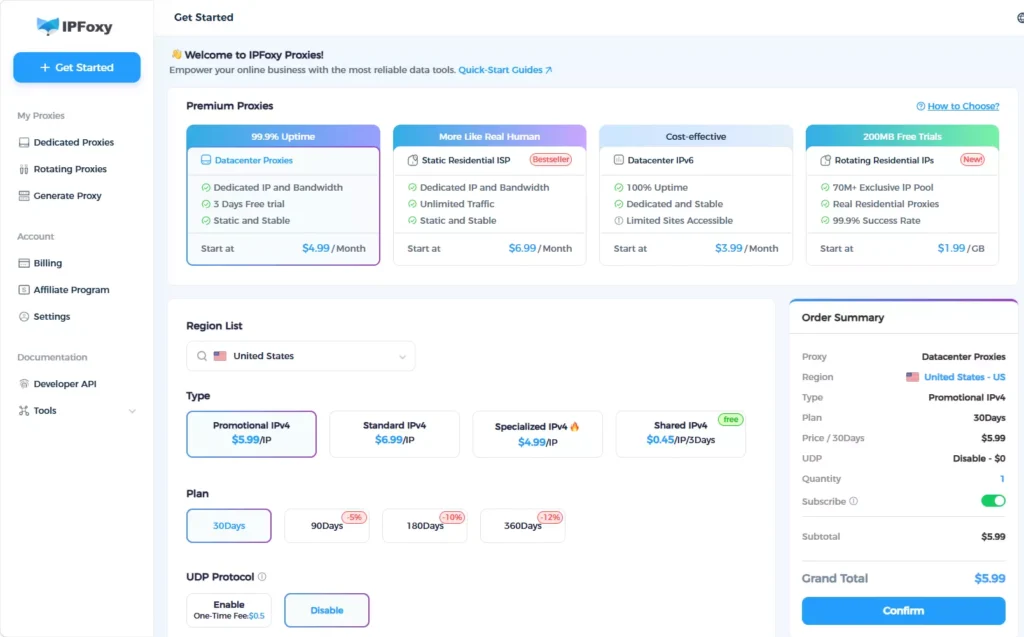
Among many service providers, IPFoxy has become an ideal choice to undertake this architectural upgrade due to its massive resources and extreme stability. Taking IPFoxy as an example, let us understand the three core metrics that need attention when testing proxy services:
1. Whether the IP Type Matches the Scenario
Different business stages need to be paired with different IP types. IPFoxy provides full-type coverage to meet diverse needs:
| Proxy Type | Characteristics and Weaknesses | Suitable Business Scenarios |
| Datacenter Proxy | Fastest speed and lowest cost. However, the IP segments are publicly known, making them easily recognized by large platforms, resulting in a lower trust score. | General access, stress testing, and internal tool invocations with low anonymity requirements. |
| Dedicated Static Residential Proxy | Originates from genuine home broadband, matching the environment of real residents. The IP remains fixed, supporting long-term session maintenance. | Long-term maintenance of core accounts. |
| Rotating Residential Proxy | Genuine residential IPs rotated from a pool on-demand at a high frequency, effectively evading risk control systems. | Short-lifecycle tasks. |
| Mobile Proxy | Originates from 4G/5G base stations, offering the highest trust score on mobile devices, though the cost is relatively high. | Mobile ad verification and scenarios requiring deep simulation of mobile environments. |
Core selection principle: Use dedicated static residential proxies for long-term stability, rotating residential proxies for high-frequency switching, data center proxies for general tasks, and mobile proxies for mobile scenarios.
2. Whether the Location is Accurate and Fully Covered
The key to preventing risk control lies in the authenticity of “localization.” When choosing a provider, pay attention to:
- City-level precise targeting: IPFoxy supports city/state-level filtering, making the account environment closer to target users and significantly reducing the probability of risk control.
- Niche region coverage: Ensure that the business can extend to regions like Southeast Asia, the Middle East, and Latin America.
- ISP filtering: Ability to specify major operators like Verizon and Vodafone to obtain a “cleaner” network source.
3. Having Stability and Technical Support
In live streaming, e-commerce store management, or automated operations, network disconnections or delays are directly related to the security of account assets.
Therefore, it is recommended to prioritize providers like IPFoxy that offer the following guarantees:
- High availability: Continuous connection stability (availability rate above 99.5%);
- High purity: Exclusive resources with a strict “cooling-off period”, never resold repeatedly;
- All-around compatibility: Perfectly compatible with mainstream Anti-detect browsers, supporting multiple protocols and major global countries/regions;
- Professional technical support: Timely customer service and technical response when network fluctuations occur.
V. Conclusion
In simple terms, a VPS solves the question of “where to run,” while a proxy solves the question of “with what identity to access”.
If you need 24-hour continuous operation or a completely isolated operating system, a VPS remains the best choice; but if you are facing challenges such as multi-account anti-association and matrix operations, then an “Anti-detect browser + proxy” is undoubtedly the lighter and more cost-effective solution at present.